

Walk into any supermarket, pharmacy, or electronics store and you'll notice them almost immediately — freestanding cardboard structures stacked with a single brand's products, positioned right where foot traffic is highest. These are corrugated POP (Point of Purchase) displays and they've quietly become one of the most effective and most affordable tools in retail merchandising.
If you're a brand manager, retailer, or marketing decision-maker evaluating display options, this guide covers what corrugated POP displays are, where they work best, their real benefits and limitations, and — most importantly — what actually drives their cost.
What Is a Corrugated POP Display?
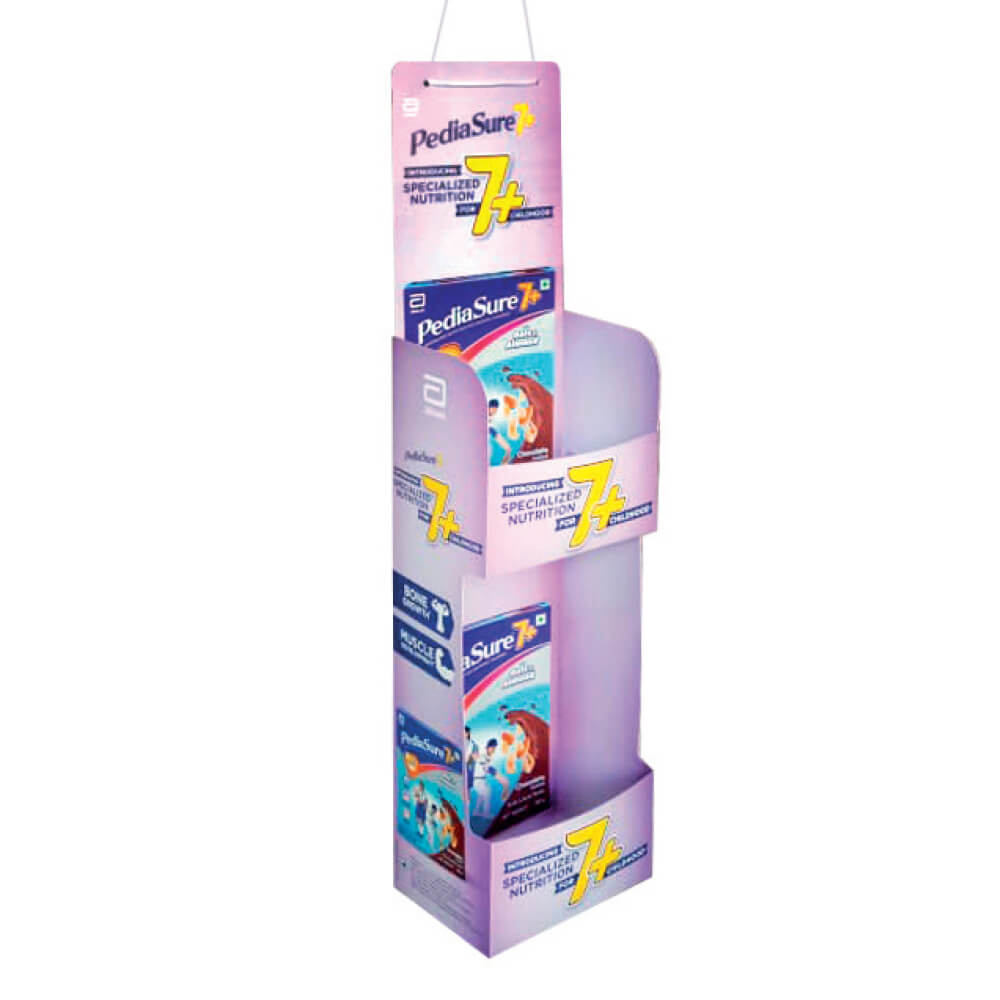
A corrugated POP display is a promotional display structure made from corrugated cardboard, used to showcase a product at a strategic point inside a retail store — near the checkout counter, at the end of an aisle, or in a high-traffic zone. Unlike a standard shelf, a POP display is built specifically to interrupt the shopper's path, draw attention to a featured product, and encourage a quicker purchase decision.
Corrugated board itself is made of a fluted (wavy) inner layer sandwiched between two flat liner sheets. That fluting is what gives a lightweight material surprising load-bearing strength — enough to hold everything from candy bars to bottled beverages to small appliances.
You'll also see this format referred to as a cardboard POP display, corrugate display, or in some markets — particularly in India — as a POSM (Point of Sale Material) display stand. All refer to essentially the same thing.
What Is a Green Board POSM Display?
Green board — a dense, non-fluted paperboard used for rigid header cards, backer panels and premium POSM components — is typically grouped under this same corrugation category. It is produced, printed and converted through the same processes as corrugated sheet and is commonly paired with a corrugated base or structure for added rigidity.
Types of Corrugated POP Displays
Not all corrugated displays look or function the same way. Choosing the right type depends on your product size, quantity, campaign length, and where in the store you'll be placed.
| Display Type | Best For | Typical Placement | Relative Cost |
|---|---|---|---|
| Counter Display | Small, low-cost impulse items (candy, small accessories) | Checkout counters | Lowest |
| Floor Display | New product launches, seasonal promotions | High-traffic aisles, store entrance | Low–Medium |
| Dump Bin | Bulky or loose overstock items | Aisle ends, clearance zones | Low |
| PDQ Tray | Pre-packed, ready-to-shelve product trays | Shelf or counter | Low |
| Endcap Display | Products needing maximum visibility | End of aisle | Medium |
| Sidekick / Power Wing | Cross-sell items next to a primary product | Side of shelving units | Medium |
| Quarter/Half Pallet Display | Mid-volume promotions | Main aisles | Medium |
| Full Pallet Display | Bulk, high-volume rollouts (club stores, grocery chains) | Main floor, multiple access sides | Medium–High |
| Parasite Display | Add-on visibility for impulse SKUs without a dedicated fixture | Clipped or hooked onto an existing gondola, shelf edge, or cooler door | Lowest |
| Corrugated Hanger | Small, hook-hung items (sachets, blister packs, stationery) | Pegboards, slatwalls, gondola end hooks | Low |
Most brands running a national or multi-store campaign will actually use two or three of these formats together — for example, a floor display for the main launch paired with a counter display for smaller cross-sell items.
Key Benefits of Corrugated POP Displays
- Cost efficiency. Corrugated is, by a wide margin, the most affordable display material available. It requires no expensive tooling, and production uses automated die-cutting and digital or flexographic printing — which keeps both short-run and bulk orders economical.
- Fast turnaround and design flexibility. Because there's no complex tooling involved, corrugated displays can move from design to production in days rather than weeks. This makes them ideal for time-sensitive launches, seasonal campaigns, or last-minute promotional pushes.
- Lightweight and easy to ship. Corrugated displays typically ship flat-packed, which significantly reduces freight costs and warehouse space compared to pre-assembled metal or wood fixtures. Flat-packing also makes bulk, multi-location rollouts far more logistically manageable.
- Simple, tool-free assembly. Most corrugated displays are designed for retail staff to assemble in under a couple of minutes without tools. Complicated setups often mean displays sit in the backroom instead of the sales floor — a risk corrugated largely avoids.
- High-impact branding surface. Every flat panel on a corrugated display is printable real estate. Digital and litho printing allow for vivid, full-color graphics, making it easy to align the display with a season, promotion, or new packaging design — and to swap designs quickly for a refresh.
- Genuine sustainability credentials. Corrugated cardboard is typically made with a significant percentage of recycled content and is fully recyclable after use. It also breaks down naturally in a matter of months rather than years, and can be paired with water-based or soy-based inks that wash out cleanly during recycling — a meaningful advantage as more retailers set sustainability requirements for vendor packaging.
- Proven impact on impulse purchases. Retail merchandising studies have repeatedly found that well-placed POP displays can meaningfully lift sales of featured items — some reports cite gains upward of 20% — largely because they interrupt a shopper's default path through the store and create a moment of focused attention on one product.
Where Corrugated Falls Short
A fair evaluation means looking at the limitations too — and most vendor content conveniently skips this part.
- Durability is built for a defined campaign window. Corrugated ships and handles reliably when flat-packed and assembled correctly, but prolonged exposure to moisture, humidity, or heavy day-to-day handling will shorten its usable life. It's engineered for temporary campaigns (typically 4–12 weeks) rather than multi-year, always-on placements.
- Weight capacity has practical limits for very heavy items. Triple-wall corrugated comfortably handles most standard retail products, though very heavy or oversized items may still need additional structural reinforcement or a different material altogether.
- Not ideal for long-running or permanent placements. If a retailer wants a fixture that stays in place for a year or more, corrugated will need to be replaced multiple times — and that repeat cost adds up.
- Corrugated vs. foldable/reusable systems. Some manufacturers now offer patented foldable or modular display systems designed for reuse across multiple campaigns instead of one-time disposal. For a single short campaign, corrugated is almost always cheaper upfront. But for brands running the same promotional format repeatedly across a year, a reusable system can work out cheaper over multiple cycles — it's worth running the math for your specific rollout frequency before defaulting to corrugated.
Cost Factors: What Actually Drives the Price
There's no single "price" for a corrugated POP display — costs vary widely based on a handful of factors:
Material tier
- Single-wall corrugated: thinnest, most economical, suited to lightweight products
- Double-wall corrugated: added strength for moderate loads
- Triple-wall corrugated: maximum strength, used for heavier products or larger structures
- Flute type (A, B, C, or E) also affects stacking strength versus print quality — finer flutes (like E-flute) give sharper graphics, while thicker flutes (A-flute) prioritize strength
- Green board: a dense, non-fluted paperboard variant, grouped under the same corrugation category and used for rigid header cards, backer panels, and premium POSM components
Size and structure complexity
Small countertop or PDQ displays are the cheapest to produce and ship. Full floor displays and pallet units need more material, more structural engineering, and more robust corrugated board — all of which increase per-unit cost.
Printing method and graphics coverage
- Flexographic printing: cost-effective for large volume runs
- Digital printing: better suited to shorter runs and quick turnarounds, with excellent color accuracy
- Litho-laminated printing: highest visual quality, typically used for premium campaigns
Full-panel, high-resolution graphics cost more than displays with minimal print coverage.
Order quantity
Like most print and packaging production, unit cost drops significantly as volume increases. A 100-unit order will have a noticeably higher per-unit price than a 5,000-unit national rollout, since tooling, printing setup, and production costs are spread across more units.
Shipping and logistics
Flat-pack shipping keeps freight costs down, but larger displays still cost more to move — particularly for multi-location rollouts. Brands sourcing displays internationally should also factor in import duties and lead times.
Typical price ranges
As a general guide, temporary corrugated displays commonly range from a few dollars per unit for simple counter displays up to $100–150+ per unit for larger, fully-branded floor displays with complex printing — though the only way to get an accurate number is a project-specific quote based on your size, material, and print requirements.
Corrugated vs. Permanent Displays: The Real Math
It's tempting to assume corrugated is always the cheaper choice simply because the unit price is lower. But if you're running a long-term, multi-store program, it's worth doing the full-cycle math.
A permanent display might cost more upfront per unit, but if a corrugated display needs to be replaced every couple of months across hundreds or thousands of stores over a full year, the cumulative cost of repeated production and shipping can end up exceeding the one-time cost of a durable fixture. Corrugated wins clearly for short campaigns, test markets, and seasonal pushes. Permanent or semi-permanent materials can make more financial sense for evergreen, always-on placements. The right choice depends entirely on your program's duration and replacement cycle — not just the sticker price of a single unit.
How to Measure Whether Your Display Is Working
Once your corrugated POP display is live, track:
- Foot traffic near the display location
- Conversion rate — the percentage of shoppers who interact with the display and complete a purchase
- Before-and-after sales comparison for the featured product
- Cost per display versus incremental sales generated
- Shopper feedback, where possible, on visibility and appeal
These metrics help you decide whether to repeat the same display design for future campaigns or adjust the format, placement, or messaging.
Frequently Asked Questions
What is a corrugated POP display used for?
It's used to showcase a specific product at a high-visibility location in a retail store — such as a checkout counter, aisle end, or store entrance — to drive attention and impulse purchases.
How much does a corrugated POP display cost?
Cost varies by size, material thickness, print method, and order quantity — ranging from a few dollars for a simple counter display to well over $100 per unit for a large, fully-branded floor display.
Are corrugated POP displays eco-friendly?
Yes. Corrugated cardboard typically contains recycled content, is fully recyclable, and decomposes naturally within a few months, especially when paired with water-based or soy-based inks.
How long do corrugated POP displays last?
They're built for temporary use — generally 4 to 12 weeks — making them ideal for seasonal or short-term promotional campaigns rather than permanent installations.
Is corrugated or a reusable/foldable display better?
For a single short campaign, corrugated is typically cheaper upfront. For a program running the same display format repeatedly over a year or more, a reusable or foldable system may cost less over multiple cycles.
The Bottom Line
Corrugated POP displays remain one of the most practical tools in retail merchandising because they solve a specific problem well: getting a product noticed, quickly and affordably, without a long production cycle or heavy upfront investment. They're not the right fit for every scenario — permanent placements and very heavy products need a different material — but for seasonal campaigns, product launches, and promotional pushes, few options match their combination of cost, speed, and visual impact.
If you're planning your next retail activation, start with your campaign length and replacement cycle. That single factor will tell you more about whether corrugated is the right choice than any spec sheet will.
