

Walk down any well-merchandised retail aisle — a supermarket, a pharmacy, an electronics store — and you'll spot at least one branded structure standing apart from the regular shelving, fully stocked with a single brand's products. That's an FSDU. It's one of the most widely used tools in retail merchandising, yet the term itself still confuses a lot of people outside the point-of-sale industry. This guide breaks down exactly what an FSDU is, how it differs from similar-sounding display formats, the types available, which materials suit which use case, and how to think about choosing one for your brand.
FSDU Meaning: What Does FSDU Stand For?
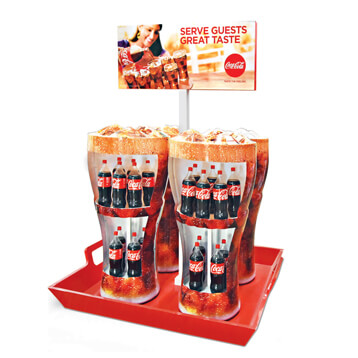
FSDU stands for Free-Standing Display Unit — also commonly called a Floor-Standing Display Unit. Both terms are used interchangeably across the retail, packaging, and point-of-sale industries, and they mean exactly the same thing: a standalone retail display that sits directly on the floor, independent of a store's fixed shelving, and holds product for sale or promotion.
The defining feature of an FSDU is that it's free-standing — it doesn't attach to or depend on existing store fixtures. That's what allows it to be placed almost anywhere: at the end of an aisle, near a store entrance, next to a checkout, or in an open floor gap that would otherwise go unused.
In India, you'll also hear the same product referred to under the broader umbrella term POSM (Point of Sale Material), or simply a "display stand" or "floor display." FSDU is the more precise, internationally recognized term for this specific category of POSM.
FSDU vs. POS, POP, CDU and POSM — Clearing Up the Terminology
The point-of-sale industry has a habit of using overlapping acronyms. Here's how they actually relate to each other:
- POS (Point of Sale) / POP (Point of Purchase) — broad umbrella terms covering any display or material used at or near the point where a customer decides to buy. An FSDU is one specific type of POS/POP display.
- FSDU (Free-Standing / Floor-Standing Display Unit) — a POS display that stands independently on the floor.
- CDU (Counter Display Unit) — a smaller display designed to sit on a counter or checkout desk, not the floor. Same purpose as an FSDU, different placement and scale.
- POSM (Point of Sale Material) — the term most commonly used in India and across Asia to describe the entire category of in-store branding and display materials, including FSDUs, CDUs, danglers, wobblers, and more.
- Dump Bin — a specific FSDU sub-type designed to hold a large stack of loose, identical product for grab-and-go browsing.
- Off-Fixture Display — any FSDU deliberately positioned away from the main shelving run, such as an aisle-end stand.
In short: if it's a standalone unit sitting on the shop floor holding your product, it's an FSDU — regardless of which regional term your market prefers.
Why Brands Use FSDUs
FSDUs remain one of the most effective merchandising tools available for a simple reason: most in-store purchase decisions, especially impulse purchases, happen at the shelf or display itself, not before the shopper enters the store. An FSDU gives a brand a dedicated, branded space that isn't competing directly with a dozen other products on a crowded shelf.
Independent research from the retail display industry has found that a meaningful share of shoppers make spontaneous purchases — or even switch brands — simply because a product was showcased attractively on a free-standing display, rather than being one of many options on a regular shelf. That single insight is why FSDUs are a permanent fixture of new product launches, seasonal campaigns, and category-defending placements.
Key advantages include:
- Full creative control. Unlike a shelf slot governed by a retailer's planogram, an FSDU is designed entirely around your brand and product.
- Placement flexibility. It can go anywhere the retailer allows — entrance, aisle end, checkout zone — independent of existing fixtures.
- Strong impulse-purchase driver. Disrupting a shopper's normal path through the store increases the odds of an unplanned purchase.
- Scalable across formats. The same core design can be adapted into countertop, quarter-pallet, or full-pallet versions depending on the retail environment.
Types of FSDUs
FSDUs aren't a single fixed format — the right type depends on your product, campaign length, and the retail environment you're placing it in.
| FSDU Type | Best For | Typical Use Case |
|---|---|---|
| Full-Pallet Display | High-volume, bulk product | National rollouts, grocery/club stores, arrives pre-stocked on a standard pallet footprint |
| Quarter/Half-Pallet Display | Mid-volume promotions | Smaller floor footprint, still pallet-compatible for logistics |
| Dump Bin | Loose, identical, grab-and-go items | Confectionery, accessories, clearance/overstock |
| Shelf-Based FSDU | Boxed or bottled products needing organized tiers | Beverages, packaged food, personal care |
| Hooked / Pegboard FSDU | Blister-packed or hanging SKUs | Small accessories, batteries, stationery, hardware |
| Hybrid FSDU | Mixed product formats | Combines shelves, hooks, and literature holders in one unit |
| Interactive / Digital FSDU | Experience-led launches | Tablet-integrated stands, QR/motion-triggered elements for premium or tech-forward campaigns |
Most large campaigns actually deploy more than one type together — for instance, a full-pallet FSDU for the main product run, paired with a smaller countertop CDU near the till for a complementary item.
Choosing the Right Material for Your FSDU
This is where most generic guides stop short — they'll tell you "cardboard, plastic, or metal" and leave it there. In practice, the right material depends on campaign duration, product weight, budget, and how many display cycles you expect to run.
Corrugated Cardboard The most common FSDU material by far. Lightweight, cost-effective, fully recyclable, and quick to produce with no expensive tooling. Ideal for temporary campaigns (roughly 4–12 weeks), seasonal promotions, and product launches where speed to market matters more than long-term durability. Ships flat-packed, which keeps freight costs down for multi-store rollouts. Explore our corrugated display capabilities for short-run and seasonal FSDU projects.
Metal:Used where an FSDU needs to survive months or years of continuous retail use — think permanent or semi-permanent category displays rather than short campaigns. Metal FSDUs handle heavier product loads with ease and hold their shape far longer than cardboard, but cost significantly more upfront and require longer lead times.
Wood & Acrylic The go-to choice when the display itself needs to communicate a premium brand positioning — cosmetics, jewellery, spirits, electronics. Acrylic in particular offers a high-end, glass-like finish that corrugated simply can't replicate, while wood adds a tactile, boutique feel. Both cost more than cardboard and are heavier to ship, but they're built for long-term, flagship placements rather than rotating promotions. See examples of our wood and acrylic display work built for long-term, flagship placements rather than rotating promotions.
Thermoformed Plastic A middle ground between cardboard and metal/acrylic — thermoforming allows for more complex molded shapes and textures than corrugated board while remaining lighter and generally cheaper than metal. It's a strong option for semi-permanent displays (roughly 3–12 months) that need more durability than cardboard but don't require the cost or weight of metal.
| Material | Lifespan | Relative Cost | Best For |
|---|---|---|---|
| Corrugated Cardboard | 4–12 weeks | Lowest | Launches, seasonal promos, fast rollouts |
| Thermoformed Plastic | 3–12 months | Low–Medium | Semi-permanent, mid-durability needs |
| Wood & Acrylic | 1+ years | High | Premium brand positioning, flagship stores |
| Metal | Multi-year | Highest | Permanent fixtures, heavy product loads |
If your brand runs the same FSDU format repeatedly across multiple campaign cycles per year, it's worth running the cost math on a more durable material rather than defaulting to cardboard each time — the cumulative cost of repeated corrugated production can, in some cases, exceed a one-time investment in a reusable structure.
What to Consider Before Ordering an FSDU
- Campaign duration — short promotional windows favor corrugated; year-round placements justify metal, wood, or acrylic.
- Product weight and shape — heavier or irregularly shaped products need reinforced structures or a sturdier material entirely.
- Retailer compliance requirements — many large retail chains have specific footprint, height, and pallet-compatibility rules for floor displays; confirm these before finalizing structural design.
- Logistics and assembly — flat-packed designs reduce freight cost and let in-store staff assemble the unit without tools, which matters when rollouts span hundreds of locations.
- Branding and messaging — keep on-display messaging simple and scannable; shoppers typically engage with an FSDU for only a few seconds.
- Sustainability requirements — an increasing number of retailers now require recyclable materials and water-based inks as a condition of accepting third-party displays.
Frequently Asked Questions
What does FSDU stand for?
FSDU stands for Free-Standing Display Unit, also referred to as a Floor-Standing Display Unit. Both terms describe the same product and are used interchangeably.
What is the difference between an FSDU and a CDU?
An FSDU stands independently on the floor, while a CDU (Counter Display Unit) is a smaller display designed to sit on a counter or checkout desk. Both serve the same merchandising purpose at a different scale and placement.
What is the difference between an FSDU and POSM?
POSM (Point of Sale Material) is the broader category covering all in-store branding and display materials. An FSDU is one specific type of POSM — the standalone, floor-standing kind.
What material is best for an FSDU?
It depends on how long the display needs to last. Corrugated cardboard suits short campaigns and seasonal promotions; thermoformed plastic suits semi-permanent use; metal, wood, and acrylic suit long-term or premium, flagship placements.
How long does an FSDU last?
A cardboard FSDU is typically built for 4–12 weeks of use. Thermoformed units can last several months, while metal, wood, and acrylic FSDUs are built for a year or more of continuous use.
Where are FSDUs typically placed in a store?
Common placements include aisle ends, store entrances, checkout zones, and open floor gaps in high-traffic areas — anywhere a brand wants a dedicated, uncontested space away from standard shelving.
The Bottom Line
An FSDU is, at its core, a simple idea executed well: give a product its own dedicated, branded space on the retail floor instead of competing for attention on a crowded shelf. The right choice of type and material comes down to how long your campaign runs, how heavy your product is, and how premium your brand positioning needs to feel. Get those three questions answered first, and the rest of the decision — cardboard or metal, pallet or countertop — becomes straightforward.
